Excavation work at Tell el-Abqain in Egypt’s Beheira Governorate has revealed the residential heart of a New Kingdom frontier fortress. In addition to planned streets and rooms built with mud bricks, archaeologists discovered grain storage facilities, ovens, inscriptions from officials of the Royal Government, holy charms, and the carefully arranged burial of a small horse. The finds demonstrate that, apart from fighting, the Egyptians had built a place where their soldiers were provided with food, uniforms, shelters, and what they saw as protection from divine forces.
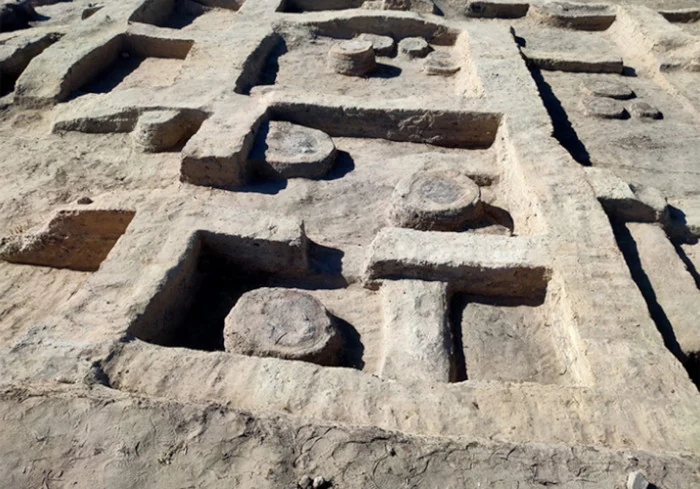
Part of the residential complex at the New Kingdom fortress discovery at Tell el-Abqain, Egypt. (MOTA)
A Fort with Streets, Stores and Ovens
The Egyptian Ministry of Tourism and Antiquities hasstated in its announcement of the discoverythat a residential complex has been found in the northern part of site. The complex had a main street of nearly four meters wide running from east to west, meeting another street going south to north. The entrance connected with the southern gate of the fortress. The layout of the complex I indicated a deliberate urban organization within the fortress built for protecting the western Delta from attacks carried out by Libyan tribes.
Grain silos and barrel-shaped pottery kilns were found in rooms adjacent to the streets. Storage areas nearby contained large pots with evidence of burnt wheat. The findings show how the food reserves were processed. This practical find is consistent with earlier findings reported byAncient Origins, which reported having discovered barracks, granaries, ovens and a bronze sword with the name of Ramesses II.
- Massive New Kingdom Fortress Discovered on Ancient Horus Military Road
- 3,500-Year-Old Egyptian Royal Retreat Found in the Sinai Desert
The complete burial of a young horse found at Tell el-Abqain. (MOTA)
A Horse Burial and Signs of Military Life
One of the standout discoveries is a burial of a complete young horse. The preliminary analysis reveals that it is a horse of medium size and built to be fast and agile, traits suitable for riding, military purposes, or as a draught horse. As it was a complete skeleton with the head carefully positioned, the researchers assume that the burial was performed purposely or even ceremonially.
Pieces of alabaster and limestone found nearby may have belonged to the decorative finials of a chariot harness. This discovery brings out the military significance of the site.
- Unique 13th-century-BC Water Wells Discovered Near Fortress in Sinai
- Newly Discovered Fortress on Way of Horus in Egypt Stood Sentinel
Three stone wells at the southeastern part of the stronghold, which were previously found to have inscriptions from the time of Pharaoh Ramesses II, are indicative of the importance of water to everyday life. A similar case can be seen through thewater wells of a stronghold of Sinai,which illustrates how important reliable sources of water were for the Egyptian military.
Several limestone stelae were also uncovered. (MOTA)
Royal Names, Gods and a Frontier Community
The excavation finds were not limited to just military artifacts. A fragment of a limestone stela containing a hieratic inscription has also been discovered which belongs to Merneptah and states that the king’s strength was equal to Seth’s, and invokes Ptah. Another fragment contains the royal names of Ramesses II. A visual scene represents a restrained captive person with Libyan Meshwesh clothing, emphasizing the military issues which the fortress was built to control.
Limestone segment associated with King Merneptah, plus scarabs mentioning various other pharaohs, loom weights and needles. (MOTA)
Scarabs naming Ramesses II, Seti I, Amun, Sekhmet, Ptah and Seth, together with amulets shaped as fish, lotus flowers, cobras, the ‘nefer’ sign and baboons, reveal the religious world of the residents. Pottery used for cooking, serving, perfume and oil, along with loom weights, grinding stones, balance weights and jewelry, fills out the picture of ordinary daily life.
Frontier forts worked as logistical and social centers as much as watch posts. The discovery is still developing, and the Egyptian mission says excavation, study and documentation will continue. For now, Tell el-Abqain offers something more revealing than a list of weapons: it shows how defense depended on streets, stored grain, ovens, water, animals, ritual and the people who kept the border functioning.
Top image: Excavated military items, stelae and carved amulets excavated a Tell el-Abqain New Kingdom fortress, Egypt. Source:Egyptian Ministry of Tourism and Antiquities, via Smithsonian Magazine
References
Archaeology Wiki. 2026. New Kingdom Fortress Discovered at Tell el-Abqain. Available at:https://www.archaeology.wiki/blog/2026/09/17/new-kingdom-fortress-discovered-at-tell-el-abqain/
Manners, G. 2024. Military Barracks & Ramses II Sword Found in Egypt. Available at:/news-history-archaeology/tell-al-abqain-military-barracks-0021409
Ministry of Tourism and Antiquities. 2026. New archaeological discovery at Tell el-Abqain reveals military and daily life inside a New Kingdom fortress. Available at:https://mota.gov.eg/ar/%D8%A7%D9%84%D8%A3%D8%AE%D8%A8%D8%A7%D8%B1-2-1-1/%D9%83%D8%B4%D9%81-%D8%A3%D8%AB%D8%B1%D9%8A-%D8%AC%D8%AF%D9%8A%D8%AF-%D8%A8%D8%AA%D9%84-%D8%A7%D9%84%D8%A3%D8%A8%D9%82%D8%B9%D9%8A%D9%86-%D8%A8%D8%A7%D9%84%D8%A8%D8%AD%D9%8A%D8%B1%D8%A9-%D9%8A%D9%83%D8%B4%D9%81_%D8%AA%D9%81%D8%A7%D8%B5%D9%8A%D9%84_%D8%A7%D9%84%D8%AD%D9%8A%D8%A7%D8%A9_%D8%A7%D9%84%D8%B9%D8%B3%D9%83%D8%B1%D9%8A%D8%A9_%D9%88%D8%A7%D9%84%D9%8A%D9%88%D9%85%D9%8A%D8%A9_%D8%AF%D8%A7%D8%AE%D9%84_%D8%A3%D8%AD%D8%AF_%D8%AD%D8%B5%D9%88%D9%86_%D8%A7%D9%84%D8%AF%D9%88%D9%84%D8%A9_%D8%A7%D9%84%D8%AD%D8%AF%D9%8A%D8%AB%D8%A9/
Pandey, S. 2022. Unique 13th-century-BC Water Wells Discovered Near Fortress in Sinai. Available at:/news-history-archaeology/sinai-water-wells-0016478
Smithsonian Magazine. 2024. These Ancient Egyptian Barracks Paint a Vivid Picture of Military Life During the Reign of Ramses II. Available at:https://www.smithsonianmag.com/smart-news/these-ancient-egyptian-barracks-paint-a-vivid-picture-of-military-life-during-the-reign-of-ramses-ii-180985082/
Gary Manners