In the hills of north-west Morocco, overlooking the river that gives the site its name, research at Oued Beht is bringing to light a previously unknown chapter of the region’s past. The discovery of a substantial built structure suggests that, during the second millennium BC, communities in north-west Africa were actively shaping their environment. They were also engaging in broader networks of interaction across the Mediterranean world.
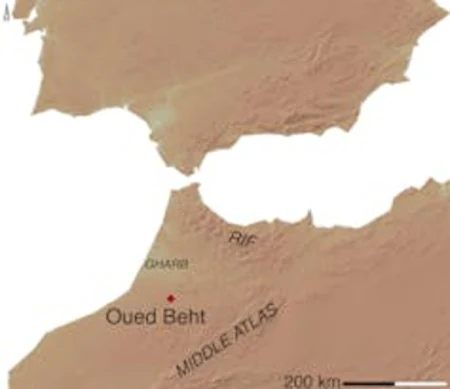
Map of Oued Beht in today’s Morocco, separated from Spain above it by the ocean. (Toby Wilkinson/OBAP Archive)
Previous research by theOued Beht Archaeological Projecthad alreadybrought to lightwhat is likely the earliest and largest agricultural complex ever discovered in Africa outside theNile Valley.It dates to around 5,400 to 4,900 years ago. New excavations carried out in 2023 – in which we took part – have now deepened our understanding of the site.
Ournew studyshows how we uncovered the earliest known large-scale construction of a probably defensive nature in north Africa beyond theNile Valley.It’s about 4,000 to 3,500 years old.
It’s not known exactly what threats these wall-like structures were designed to counter. They likely relate to increasing competition over land, resources, and possibly control of movement through the landscape, rather than to “invaders”. Constructions like these suggest communities felt the need to protect themselves or assert power over strategic locations.
- First Bronze Age Settlement Found in Maghreb (Morocco), Dating to 2,000 BC
- Bronze Age Ritual Landscapes Found in Prehistoric Tangiers Rewrites History
Surveying around the wall found at Oued Beht. (Giulio Lucarini/OBAP Archive)
This discovery pushes back the evidence for organized defensive architecture in the Maghreb and suggests that societies in this region at this time were more complex and structured than previously believed.
Our studyalso reveals how the ridge of Oued Beht would become a focal point again in the medieval period, during the 11th to 13th centuries AD. The same defensive structure was rebuilt, a hamlet or farm was established on a nearby hilltop, and people were buried in a cemetery between the two areas.
Together these findings provide rare archaeological insights into rural communities during both prehistoric and medieval times. They help us understand how societies developed and maintained themselves in a region too often left out of the history books.
A prehistoric hub in the Maghreb
For a long time, the later prehistory of north Africa’s Maghreb region (the Mediterranean countries ofMorocco, Algeria, andTunisia) has been poorly understood. Compared with neighboring areas such as Iberia in south-western Europe or Athens in the eastern Mediterranean, archaeological evidence was often fragmentary. In the last few years this has changed completely.
Exposed skeletal remains at Oued Beht. (Marlena Cygan/OBAP Archive)
Excavations at Oued Beht have revealed a large concentration of human activity spread across at least ten hectares. The earliest major phase dates to the mid-fourth and early third millennia BC, or the FinalNeolithicperiod.
Environmental evidence from plant and animal remains in the prehistoric era indicates a farming community cultivating crops such as barley and wheat. They also exploited wild plants and kept livestock.
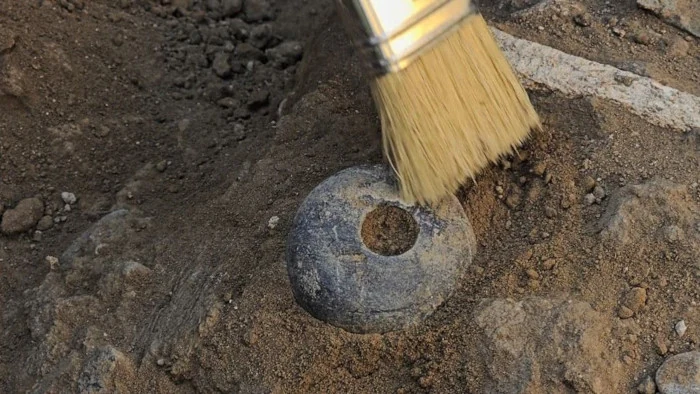
Polished stone axe at Oued Beht. (Hamza Benattia/OBAP Archive)
The site was also an important center of craft production. Thousands of polished stone axes and other tools have been discovered, along with finely made pottery, sometimes decorated with painted patterns.
It’s still uncertain whether prehistoric Oued Beht functioned as a permanent village, a seasonal center, or something less familiar. But it was clearly a major focus in the landscape of north-west Morocco.
The Defensive Wall
The presence of potentially ancient earthworks and walls had been noted since the 1930s. The French archaeologist Armand Ruhlmann first documented a configuration of three walls, with the fourth side protected by the natural scarp of the ridge, describing a defensiveéperon barré(barred spur). Their precise nature and date remained uncertain until now.
The barred spur, near the village of Aït Siberne. (Arnau Garcia-Molsosa/Toby Wilkinson/OBAP Archive)
New excavations have clarified the existence of a multi-phase ditch, rampart and wall built across a narrow section of the Oued Beht ridge between the river and a ravine. This cut off and protected the ridge’s southern tip.
Radiocarbon dating of deposits associated with these structures gave us the timelines in our study.
Section profile of the wall, embankment and ditch. (Alessia Brucato/Lucy Farr/Moad Radi/OBAP Archive)
They place its original construction at a time equivalent to the Bronze Age of the remaining western Mediterranean. This makes it the earliest confirmed defensive construction in north Africa outside Egypt.
What was this construction for?
This structure raises important questions about the society that built it. Building an embankment and ditch system required planning, coordination and the mobilization of labor. This suggests a community capable of organizing complex construction initiatives.
Drone photo of the site. (Arnau Garcia-Molsosa/Toby Wilkinson/OBAP Archive)
During the earlier Neolithic phase, activity at Oued Beht focused on the larger and more open northern area of the site. By the period of our new study, focus had shifted to the narrower, more defensible southern ridge. This may reflect a shift in settlement strategies.
Mediterranean Connections
The second millennium BC was a dynamic period across the Mediterranean. In southern Iberia,Argaric societies(about 2200-1550 BC) in today’s Europe were developing complex, often hilltop settlements. They were characterised by planned architecture, advanced metallurgy (especially bronze production), and marked social hierarchies visible in burial practices. These communities often constructed fortified sites, and strategically located settlements controlling surrounding territories.
Increasing evidence suggests that communities in north-west Africa were connected to wider Mediterranean networks. This includes today’s Spain and Portugal. The discoveries at Oued Beht indicate that the Maghreb was not isolated. It participated in broader processes shaping the western Mediterranean.
The defensive system at the site may reflect wider transformations in social organisation and regional interaction. There may have been growing competition over resources, control of movement, and more formalised leadership structures.
Rewriting History
The discoveries at Oued Beht highlight how much remains to be learned about the deep history of north Africa. The defensive wall shows that communities here were able to coordinate large construction projects and points to social transformations that are only very tentatively beginning to be recognised.
The medieval remains demonstrate that the ridge was used again many centuries after the prehistoric settlement had been abandoned. Oued Beht was not simply a single-period settlement but a landscape repeatedly selected by different communities across millennia.
As research continues, this location may become key to understanding how societies in the Maghreb evolved from early farming communities to the medieval rural world.
Top image: The wall discovered at Oued Beht, a site in Morocco that is steadily rewriting the history of the Maghreb.Source: Giulio Lucarini/OBAP Archive
This article was originally published under the title ‘History is being rewritten at an archaeological site in Morocco. What the discovery of an ancient wall tells us’byGiulio Lucariniet al. onThe Conversation, and has been republished under a Creative Commons License.
- Oued
- Beht
- Africa
- morocco
- North
- site
- communities
- mediterranean
- OBAP
- archive