Archaeologists exploring the Roman-era ruins of Heraclea Sintica in southwestern Bulgaria have made an exceptionally rare discovery - a 1,800-year-old bronze surgical instrument used for the painful procedure of removing bladder stones. The specialized tool (known in antiquity as alithulkos) has provided a unique glimpse into the advanced medical practices of the ancient Roman world.
The finding, announced on July 3, was published by excavation director Professor Lyudmil Vagalinski ofArchaeologia Bulgarica. This surgical instrument was part of an advanced kit used by ancient surgeons to perform a lithotomy, the delicate and dangerous procedure to extract bladder stones. According to researchers, this find is highly significant as only one other comparable instrument has ever been discovered, which was found in Italy.
- 2,000 Year Window into the World of Roman Medical Techniques
- Physician's Tomb Holds Comprehensive Set of Roman Medical Tools
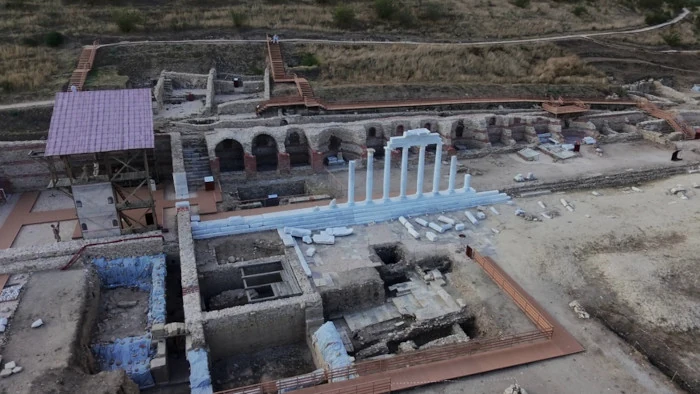
The excavation site of Heraclea Sintica, an ancient city that flourished in present-day Bulgaria in the third century AD. (Jan Stożek/CC BY-SA 4.0)
The Scourge of Bladder Stones in the Ancient World
The newly unearthed surgical tool once had curved hooks on its working end, though these did not survive the centuries. However, the bronze handle of the instrument, adorned with a series of embossed rings, remains remarkably well-preserved. A surgeon would use such a tool after making an incision in the perineum to reach and extract the painful stones.
Bladder stones were considered one of the most agonizing medical conditions in the ancient world. The renowned Roman authorPliny the Elderdescribed the intense suffering caused by the affliction. In the third century BC, the Greek physician Ammonius of Alexandria became famous for devising specialized surgical procedures and instruments to treat the condition, earning him the moniker "Lithotomos" or "The Stone Cutter."
- Ancient Medicine: How Did Ancient Civilizations Heal Themselves?
- Ancient Greek Physician Hippocrates and the Medical Revolution
An illustration of the lithotomy procedure, showing the specialized tools used to extract bladder stones. (Surgery at the Edward Worth Library)
Advanced Medicine at Heraclea Sintica
While archaeologists frequently uncover generalsurgical toolslike scalpels, needles, and spoons, finding a highly specialized instrument like the lithulkos is extremely unusual. The operation was considered so risky and advanced that it is even mentioned in the famousHippocratic Oath, which urged that the procedure be left only to practitioners with specific training.
"The instrument is an extremely rare find not only for Bulgaria, but also worldwide," Professor Vagalinski stated. This suggests that during the third century AD, when the city was experiencing major economic growth under the Roman Empire,Heraclea Sinticawas home to highly trained medical professionals capable of performing complex surgeries.
A Healing Temple?
Adding to the intrigue is the specific location where the instrument’s placement has led archaeologists to hypothesize that the temple complex may have served a dual purpose, catering to both spiritual and physical well-being.
"The fact that we found it in a room next to the temple of Heracles suggests that perhaps people were treated there, seeking the help of the mythical hero and son of Zeus," Professor Vagalinski explained. It is possible that pilgrims traveled to the temple seeking divine intervention, and while there, also received practical medical treatment from resident physicians.
Excavations at the site are ongoing, with researchers working to remove thick river sediment to expose more of the ancient city's architecture. Archaeologists hope to uncover more evidence of the sophisticated medical practices of the ancient Roman era and gain further insight into daily life at Heraclea Sintica.
Top image: The specialized tool found at Heraclea Sintica that physicians used to remove bladder stones during the Roman era. Source:Archaeologia Bulgarica
References
Archaeologia Bulgarica. 2026. Ancient instrument for removing bladder stones discovered in Heraclea Sintica. BNR News. Available at:https://bnrnews.bg/en/post/498439/ancient-instrument-for-removing-bladder-stones-discovered-in-heraclea-sintica
Milligan, M., 2026. Ancient bladder stone surgery tool discovered at Bulgarian Roman city. Heritage Daily. Available at:https://www.heritagedaily.com/2026/07/ancient-bladder-stone-surgery-tool-discovered-at-bulgarian-roman-city/158530
Spitz, E., 2026. Researchers exploring the Roman-era ruins of Heraclea Sintica have unearthed an 1,800-year-old bronze lithulkos, an ancient surgical tool used to remove bladder stones with a hook. All That's Interesting. Available at:https://allthatsinteresting.com/bulgaria-ancient-bladder-surgery-tool
Gary Manners