For more than three decades, an impressive underwater hoard of 43 iron helmets found off the coast of Spain was believed to be a relic of the ancient Roman era. Now, a groundbreaking new study has shifted the historical narrative forward by over a millennium. Modern scientific analysis has revealed that the helmets are not Roman at all, but rather a key source of evidence for understanding the commercial and military networks of the Late Medieval Mediterranean — and the largest single assemblage of medieval helmets ever found in the western Mediterranean.
The helmets were initially unearthed in 1990 at the Piedras de la Barbada underwater archaeological site, near Benicarló in the province of Castellón, eastern Spain. They were discovered by chance when local fishermen accidentally snagged two large, heavily corroded metallic blocks in their nets. Because they were found in an area that also yieldedRoman anchor stocks, amphorae, and much older bronze helmets, archaeologists naturally assumed the iron calottes belonged to the same ancient period. That assumption has now been overturned.
A Rare Survival Inside Corroded Iron
The research, led by doctoral student Manuel Frallicciardi under joint supervision between the University of Alicante and the University of Salerno, has enabled a complete reassessment of this remarkable assemblage. Published in the Cambridge University Press journalAntiquity, the study places the manufacture of the weaponry between the late 14th and early 15th centuries, completely dismantling the Roman attribution that had stuck to the find since its recovery.
- Full Suit of Armor Discovered in Spanish Castle Excavation
- Wreck-Hunters Uncover A 'Great Maritime Horror' in the Mediterranean
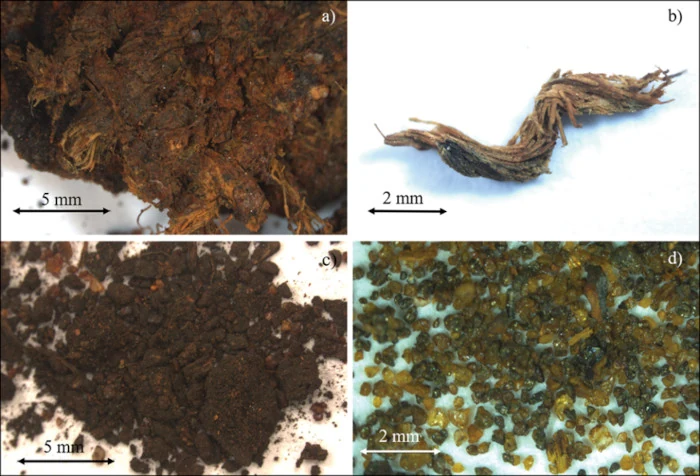
Microphotographs of the collected samples: a) textile from the helmet interior; b) fiber with Z-twist; c) metallic corrosion products; d) adhered marine sediment.(M. Frallicciardi/Antiquity Publications Ltd)
The discovery is unusual not only because of the helmets themselves but because of what survived inside them. Underwater iron artifacts rarely preserve organic material, as salt water, oxygen, microorganisms, and corrosion usually erase textiles long before researchers can study them. In this case, the sea created an accidental archive. The helmets had fused into large concreted masses of iron, sediment, and carbonate deposits. Within that hardened shell, fragments of plant-fibre textile survived in functional positions inside several helmet calottes — almost certainly the inner linings or padding that would have made the helmets wearable. This is precisely the kind of perishable material that almost never remains attached tomedieval armor.
Microscopic and spectroscopic analyses showed that the textiles were made of plant bast fibres, woven in a simple tabby structure with Z-twisted yarns. X-ray microtomography helped reveal the stratigraphy inside the helmets: marine sediment on the outside, textile below it, then iron corrosion products, and finally the original metal surface. The corrosion products and carbonate concretions helped seal the textile away from the open marine environment, giving researchers a rare chance to date the helmets directly usingradiocarbon datingrather than relying only on typological comparisons.
- Lavishly Decorated Medieval Spears Emerge from Polish Wetlands
- Huge Hoard of Viking Sword Parts Found in Estonia
Three groups of the Benicarló assemblage: a & b) correspond to the two blocks recovered at Piedras de la Barbada, currently housed in the Museo de Bellas Artes de Castellón (groups A and B); c) the detached and conserved pieces exhibited in the Museo de la Ciudad de Benicarló (group C). The images were produced from photogrammetric data (figure by M. Frallicciardi/Antiquity Publications Ltd).
Weapons for a Dangerous Coast
At least 43 helmets have been identified in the Benicarló assemblage, though the true number may be higher because some remain trapped inside the concreted blocks. Their forms include hemispherical iron calottes, some with longitudinal crests, and one faceted, ogival helmet comparable to late medieval kettle-hat traditions. Five textile samples were radiocarbon dated by accelerator mass spectrometry in two independent laboratories. Four results point to a coherent late medieval horizon, centred between the late 1300s and early 1400s.
The timing of the assemblage is historically significant. From the mid-14th century onward, the Valencian coast faced increasing insecurity.Raids and piracybecame recurring threats in parts of the western Mediterranean, especially along exposed stretches of coastline. Coastal defence systems expanded, fortified settlements became more important, and local militias or garrisons needed practical equipment. The cargo may have been destined for local militias, troops of theKingdom of Valencia, or armed companies tasked with protecting the maritime frontier.
Frallicciardi recalled that initial identification posed numerous challenges. "At the beginning, it was difficult to place them in a specific era because they featured traits that recalled both Late Roman models and potential medieval pieces inspired by classical traditions," he explained. The surprise came when scientific analysis confirmed that the typology did not match any category catalogued to date. "When I started the research, it was incredible to see that practically no known parallels existed," the doctoral student remarked. His search for references led him to some similar 14th-century iconographic representations in England, though without exact matches.
A Complex Network of Mediterranean Exchange
According to Raimon Graells, a UA lecturer and co-author of the paper, the sheer scale of the find goes beyond purely archaeological curiosity. "We are looking at direct evidence of large-scale arms trading. This discovery reveals a network of exchange and communication that was far more complex than previously thought," he noted. The research points to a flow ofmedieval weaponsbetween the coast of the Valencia Region and the major commercial hubs of northern Italy, such as Genoa, which was one of the dominant mercantile powers of the era. The presence of such a substantial shipment suggests that transporting military equipment was integrated into perfectly structured commercial circuits connecting different Mediterranean territories.
Specialists believe that all the pieces formed a single shipment when they hit the seabed. The most probable hypothesis is that the batch was packed and transported by sea when an incident occurred during loading or unloading operations. The cache was found at a depth of just six metres, right next to an area used as a jetty. Dr Graells suggested that a portion of the cargo became trapped under the sand and could not be recovered at the time, allowing the package to remain hidden for centuries, safely buried out of sight until its accidental discovery by fishermen.
The carbon-14 results ultimately confirmed that this was a poorly documented helmet shape belonging to a technological transition phase that left no later lineage. The exceptional preservation of the helmets was achieved through the combined action of marine concretions and sediment. In some specimens, these deposits sealed the fabrics lining the interior, creating stable micro-environments that protected organic materials that would normally decay. These very textile fragments proved fundamental to reconstructing the history of the hoard, and the Benicarló assemblage now stands as one of the most important underwater finds for the study ofmedieval weaponryin the western Mediterranean.
Top image: Some of the 43 helmets found off Benicarló coast now classified as medieval military cargo, not Roman artifacts.Source: M. Frallicciardi/Antiquity Publications Ltd
References
Arkeonews. 2026. Helmets Once Thought to Be Ancient Reveal a Medieval Secret Beneath Spain's Waters. Available at:https://arkeonews.net/helmets-once-thought-to-be-ancient-reveal-a-medieval-secret-beneath-spains-waters/
Frallicciardi, M. et al. 2026. Radiocarbon dating and characterisation of textiles preserved in late medieval helmets from Benicarló (Castellón, Spain ). Antiquity. Cambridge University Press. Available at:https://www.cambridge.org/core/journals/antiquity/article/radiocarbon-dating-and-characterisation-of-textiles-preserved-in-late-medieval-helmets-from-benicarlo-castellon-spain/59996BEBF9D493373F80642F304E1C3F
University of Alicante. 2026. University of Alicante redefines major Mediterranean archaeological discovery. Available at:https://web.ua.es/en/actualidad-universitaria/2026/junio2026/1-7/university-of-alicante-redefines-major-mediterranean-archaeological-discovery.html
University of Alicante. 2026. Helmet hoard off Benicarló coast trades its Roman label for far stranger medieval origins. Phys.org. Available at:https://phys.org/news/2026-06-helmet-hoard-benicarl-coast-roman.html
Gary Manners