Archaeologists reopening a Viking ship burial on Norway’s Karmøy island have found evidence of a much older monument directly underneath. At Grønhaug, a stone-built cairn and ring of stones appear to belong to a Bronze Age grave, suggesting the later ship burial was raised over an already ancient place of burial. The discovery adds a deeper layer to a site long associated with the rise of royal power in western Norway.
A ship grave reopened after 124 years
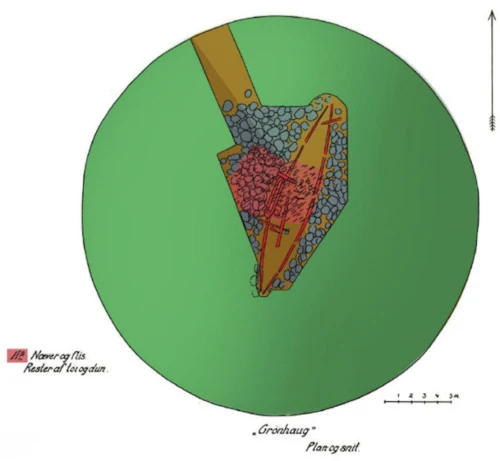
The investigation began in August 2026, when archaeologists from the Museum of Archaeology at the University of Stavanger returned to Grønhaug on behalf of the Norwegian Directorate for Cultural Heritage and Rogaland County Municipality. The mound was last examined by Haakon Schetelig in 1902, when he confirmed that a ship had been placed inside it. According toRiksantikvaren’s official announcement, the oak vessel was about 15 meters long and 2.8 meters wide, while the mound measures roughly 30 meters across and four meters high.
The new team, led by archaeologists Marie Ødegaard and Håkon Reiersen, has not opened the entire monument. Instead, it has followed Schetelig’s old trench with a small extension to assess preservation and collect samples. One or two metal rivets probably came from the ship, while pieces of pine timber discarded during the 1902 work may have belonged to a roof, superstructure or another object associated with the burial. The ship itself has deteriorated badly, but parts of the hull and bottom may still survive.
- 1300-Year-Old Pre-Viking Ship Burial Rewrites History
- Herlaugshaugen Ship Burial Legend Disproven by Study
Haakon Schetelig’s 1902 mapping of the trench and the ship. (University Museum of Bergen / CC BY, viaScience Norway)
The older monument below
The most important find lies beneath the Viking layers. The excavators reached the old ground surface and identified a man-made stone cairn covered by soil and turf, with stones arranged around its base in a feature known as a kerb. Marie Ødegaard toldScience Norwaythat the structure is “probably a Bronze Age mound,” although samples still need to be dated before that interpretation can be confirmed.
The older mound may have served as a platform for the later ship grave. That possibility fits the wider landscape, where Karmøy’s monumental burial mounds span several periods and where earlier sacred places appear to have remained visible and meaningful. The pattern recalls other discoveries discussed in1000-year-old Viking Boat Burial Discovered Under Market Square in NorwayandHuge Iron Age Longhouse Found Beside Viking Ship in Norway, where burial monuments form part of larger political and ceremonial landscapes.
- Radar Reveals a Rare Viking Ship Burial in a Field of Norway
- Two Viking Ship Burials Revealed by Archaeologists
The recent trench that has been excavated. At the far end, you can see large stones that are the core of the Bronze Age mound, while the outer stones are part of the kerb, a ring of stones around the mound. (Marie Ødegaard /University of Stavanger)
Plants preserved from the Viking Age
The excavation has also preserved an unusually vivid snapshot of the landscape buried beneath the mound. Archaeologists could see blueberry plants and heather on the old surface, and some still had leaves. Because the vegetation was growing when it was covered, the evidence suggests the mound was constructed during the warmer half of the year; it also demonstrates how well pockets of organic material survived despite ancient looting.
Close-up of plant materials unearthed in the grave. (Marie Ødegaard /University of Stavanger)
The burial’s chronology remains part of the investigation. Earlier studies placed the ship around AD 780, but more recent reviews of dendrochronological and radiocarbon evidence point to about AD 864, firmly within the Viking Age. That date links Grønhaug to the power centre at Avaldsnes traditionally associated with Harald Fairhair, while the new samples may refine both the ship’s date and the age of the monument below it. Comparable questions about elite burial, memory and reuse appear in Ancient Origins’Grave Findings Could Solve a Viking Age Mystery,Signs of Viking Age Ship Burial Found in Vestfold County, andHerlaugshaugen Ship Burial Legend Disproven by Study.
For now, the Bronze Age identification is provisional, but the implications are already significant. Grønhaug may show that Viking leaders deliberately placed a ship burial on top of an older funerary monument, turning an ancient landmark into a statement of power and continuity. Riksantikvaren has said the work forms part of a broader effort to evaluate Norway’s Viking heritage for possible future World Heritage nomination, giving the newly exposed layers importance well beyond Karmøy.
Top image: Aerial view of the Grønhaug excavation, with the mound and trench beside the Karmsundet landscape. Source:Øyvind Nesvåg/Rogaland County Municipality
References
Arkeonews, A. 14 August 2026. Older Bronze Age Burial Found Beneath Viking Ship Grave in Norway. Available at:https://arkeonews.net/older-bronze-age-burial-found-beneath-viking-ship-grave-in-norway/
Biørnstad, L. 12 August 2026. Archaeologists have opened a Viking Age ship burial. The most exciting discovery may lie beneath the ship. Available at:https://www.sciencenorway.no/archaeology-culture-the-viking-age/archaeologists-have-opened-a-viking-age-ship-burial-the-most-exciting-discovery-may-lie-beneath-the-ship/2697367
Riksantikvaren, R. 5 August 2026. Åpner vikingskipsgrav på Karmøy. Available at:https://riksantikvaren.no/apner-vikingskipsgrav-pa-karmoy/
Gary Manners